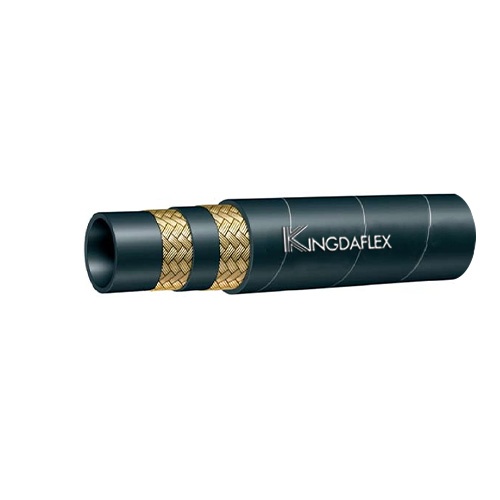
Can a hydraulic hose handle extreme pressure conditions? Yes, but only when its pressure rating, reinforcement structure, materials, and installation conditions match the application. Modern high-pressure hydraulic hoses can operate at 3,000–10,000 psi, with some specialized systems exceeding 20,000 psi during testing. Steel wire reinforcement, advanced rubber compounds, and standards such as SAE 100R12, SAE 100R13, and SAE 100R15 allow hoses to withstand repeated pressure cycles in mining, construction, aerospace, and industrial equipment.
Hydraulic hoses used in extreme environments are designed as multi-layer pressure systems rather than simple rubber tubes. A typical high-pressure hose contains an inner tube for fluid resistance, reinforcement layers for pressure strength, and an outer cover for protection. The reinforcement layer carries most of the mechanical stress created by hydraulic pressure.
In industrial applications, operating pressure can range from 1,000 psi in general equipment to more than 6,000 psi in heavy machinery. For example, hydraulic systems in mining loaders and drilling equipment often work between 4,000 and 5,000 psi, while test conditions may require hoses to withstand pressure levels four times higher than their rated working pressure.
A hydraulic hose rated at 5,000 psi working pressure may be tested near 20,000 psi before structural failure according to common safety requirements.
The pressure capability of a hose depends heavily on reinforcement design. Braided hoses use steel wire or textile layers arranged in crossing patterns, while spiral hoses use multiple layers of steel wire wrapped at specific angles. Spiral reinforcement is commonly selected for equipment that experiences high pressure pulses because it limits expansion of the hose wall.
A comparison of common hydraulic hose structures shows different pressure ranges:
| Hose construction | Typical application | Approximate pressure range |
|---|---|---|
| Single wire braid | Agricultural and light industrial equipment | 1,000–3,000 psi |
| Two wire braid | Mobile hydraulic systems | 3,000–4,500 psi |
| Four spiral wire | Construction and mining machinery | 5,000–6,000 psi |
| Six spiral wire | Ultra-high pressure equipment | Above 6,000 psi |
Material selection also affects pressure performance. The inner tube is commonly produced from synthetic rubber such as nitrile rubber (NBR), which provides resistance against petroleum-based hydraulic fluids. Thermoplastic materials such as polyurethane are used in some applications where flexibility, lower weight, and abrasion resistance are required.
Temperature conditions can change hose performance significantly. Hydraulic systems operating near engines, steel mills, or offshore equipment may expose hoses to temperatures above 100°C. According to industry material studies, rubber strength can decrease by more than 20% after long-term exposure to elevated temperatures if the compound is not designed for heat resistance.
This temperature effect is connected with chemical stability. Hydraulic fluids, ozone, moisture, and external contamination can gradually affect hose materials. A hose used in outdoor construction equipment may face sunlight exposure, mechanical contact, and temperature changes throughout the year, making the outer cover design important for service life.
The outer cover of a high-pressure hydraulic hose protects internal reinforcement wires from external damage. Abrasion-resistant covers are often used in mining and construction equipment because hoses may contact metal edges, rocks, or moving machine parts during operation.
A damaged outer cover does not always cause immediate leakage, but it can allow moisture to reach steel reinforcement and reduce pressure resistance over time.
Manufacturing accuracy has a direct influence on hose reliability. During production, manufacturers control rubber thickness, wire placement, bonding strength, and dimensional tolerance. Small differences in reinforcement alignment can create uneven stress distribution when the hose is pressurized.
Many manufacturers perform pressure impulse testing based on international standards such as SAE J343. These tests repeatedly increase and release pressure to simulate real equipment operation. Some hydraulic hoses are tested for hundreds of thousands of pressure cycles to evaluate long-term performance.
The selection of a hydraulic hose must consider several operating conditions rather than pressure rating alone.
| Factor | Influence on hose selection |
|---|---|
| Working pressure | Determines required pressure class |
| Pressure spikes | Requires additional safety margin |
| Temperature range | Affects rubber strength and flexibility |
| Fluid type | Determines chemical compatibility |
| Bend radius | Prevents reinforcement damage |
| External environment | Influences cover material choice |
A properly selected Kingdaflex hydraulic hose can be used in applications requiring reliable pressure performance when the hose specification matches the equipment requirements. Different hydraulic systems require different combinations of pressure rating, flexibility, and environmental resistance.
Pressure spikes are another factor that engineers consider when choosing hoses. Hydraulic cylinders, pumps, and valves can create sudden pressure increases during starting, stopping, or load changes. In mobile machinery, these repeated pressure changes may occur thousands of times during daily operation.
The difference between constant pressure and repeated pressure cycling is significant. A hose that performs well under steady pressure may experience faster wear when exposed to frequent pulses. This is why high-pressure hydraulic hoses for excavators, cranes, and drilling equipment often use multiple reinforcement layers.
Installation quality also affects pressure performance. Incorrect routing, excessive bending, twisting, or insufficient support can reduce hose lifespan. Manufacturers usually specify minimum bend radius values because sharp bending can damage wire reinforcement and reduce internal flow efficiency.
A typical hydraulic hose inspection includes checking several conditions:
-
Surface cracks or cuts on the outer cover
-
Leakage near fittings
-
Swelling or deformation of the hose body
-
Exposed reinforcement wires
-
Changes in flexibility or stiffness
Regular inspection intervals vary by equipment type and working environment. In heavy industrial applications, hoses may be checked weekly or monthly because operating conditions can change quickly.
Fittings and connections must also match the hose pressure rating. A high-pressure hose connected with unsuitable fittings may fail even if the hose structure itself is strong enough. Crimping dimensions, fitting materials, and connection methods are controlled during assembly to maintain pressure performance.
Modern hydraulic hose technology continues to develop through improved reinforcement materials and lighter designs. Some newer thermoplastic hoses reduce weight by 30% or more compared with traditional rubber hoses while maintaining similar pressure ratings. These designs are used in aerospace, robotics, and compact hydraulic equipment where space and weight are limited.
Extreme-pressure hydraulic applications require a complete system approach involving hose construction, material properties, testing standards, and correct installation. A hydraulic hose can handle demanding pressure conditions when each component is selected according to the actual working environment and maintained throughout its service period.