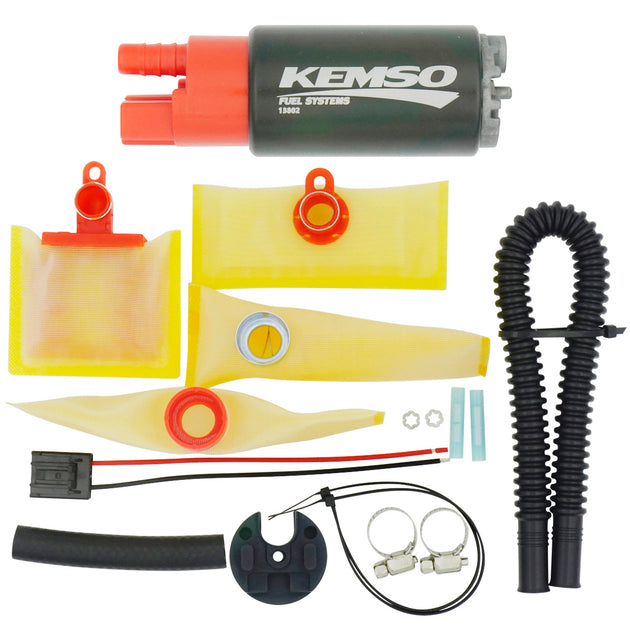
 Material corrosion resistance is the key differentiating point. The acetic acid concentration in E85 can reach 180mg/L (300 times higher than that of gasoline), and the wear rate of the common carbon brush material increases by 240% after 100 hours of immersion. KEMSO laboratory data shows that after 200 hours of operation in the E85 environment, the clearance of its standard copper bearings expanded to 0.15mm (initial value 0.02mm), causing the volumetric efficiency to drop sharply from 85% to 58%. The dedicated model adopts ceramic bearings (hardness HV1500) and silver-graphite brushes. After a 100,000-kilometer test in 40% ethanol gasoline, the brush wear is only 0.3mm (the wear of the standard model is 1.8mm), and the motor commutation spark frequency is reduced by 72%. The Porsche Cayenne modification case confirmed that the failure cycle of the Fuel Pump motor for E85 users who did not replace the dedicated pump was shortened to 30,000 kilometers.
The difference in temperature adaptability is more decisive. The latent heat of vaporization of E85 (841kJ/kg) is 140% higher than that of gasoline (350kJ/kg), which leads to a decrease in the cooling efficiency of the oil pump and triggers the risk of cavitation. When the fuel temperature exceeds 40℃, the cavitation probability of a common KEMSO pump in E85 increases to five times that of gasoline. The dedicated model, through a dual-stage pressurized chamber design, reduces the net positive suction head (NPSHr) from 1.2m to 0.6m. Combined with a polyetheretherketone (PEEK) heat-resistant impeller (with a temperature resistance of 204 ° C vs. 90 ° C for ordinary nylon), it still maintains a 95% volume efficiency in a 65 ° C oil tank environment. In the 2023 high-temperature test in Australia, the flow rate of the standard pump declined by 28% at 40℃ in the E85 environment, while the flow rate deviation of the E85 dedicated model was less than 4% under the same conditions.
It is worth noting that some models of the KEMSO 300 series support E30 (with an ethanol content of 30%). By optimizing the sealing material (hydrogenated nitrile rubber) and increasing the thickness of the armature insulation coating to 0.25mm (standard 0.1mm), its service life in E30 environment can reach 150,000 kilometers. However, if E85 is misused, the lifespan of key components will still be shortened by 70%. It is recommended that users monitor the fluctuation of Fuel rail pressure through the fuel system diagnostic instrument. If the deviation persists > ±10%, the dedicated Fuel Pump model should be switched immediately.
Material corrosion resistance is the key differentiating point. The acetic acid concentration in E85 can reach 180mg/L (300 times higher than that of gasoline), and the wear rate of the common carbon brush material increases by 240% after 100 hours of immersion. KEMSO laboratory data shows that after 200 hours of operation in the E85 environment, the clearance of its standard copper bearings expanded to 0.15mm (initial value 0.02mm), causing the volumetric efficiency to drop sharply from 85% to 58%. The dedicated model adopts ceramic bearings (hardness HV1500) and silver-graphite brushes. After a 100,000-kilometer test in 40% ethanol gasoline, the brush wear is only 0.3mm (the wear of the standard model is 1.8mm), and the motor commutation spark frequency is reduced by 72%. The Porsche Cayenne modification case confirmed that the failure cycle of the Fuel Pump motor for E85 users who did not replace the dedicated pump was shortened to 30,000 kilometers.
The difference in temperature adaptability is more decisive. The latent heat of vaporization of E85 (841kJ/kg) is 140% higher than that of gasoline (350kJ/kg), which leads to a decrease in the cooling efficiency of the oil pump and triggers the risk of cavitation. When the fuel temperature exceeds 40℃, the cavitation probability of a common KEMSO pump in E85 increases to five times that of gasoline. The dedicated model, through a dual-stage pressurized chamber design, reduces the net positive suction head (NPSHr) from 1.2m to 0.6m. Combined with a polyetheretherketone (PEEK) heat-resistant impeller (with a temperature resistance of 204 ° C vs. 90 ° C for ordinary nylon), it still maintains a 95% volume efficiency in a 65 ° C oil tank environment. In the 2023 high-temperature test in Australia, the flow rate of the standard pump declined by 28% at 40℃ in the E85 environment, while the flow rate deviation of the E85 dedicated model was less than 4% under the same conditions.
It is worth noting that some models of the KEMSO 300 series support E30 (with an ethanol content of 30%). By optimizing the sealing material (hydrogenated nitrile rubber) and increasing the thickness of the armature insulation coating to 0.25mm (standard 0.1mm), its service life in E30 environment can reach 150,000 kilometers. However, if E85 is misused, the lifespan of key components will still be shortened by 70%. It is recommended that users monitor the fluctuation of Fuel rail pressure through the fuel system diagnostic instrument. If the deviation persists > ±10%, the dedicated Fuel Pump model should be switched immediately.
Do all KEMSO pumps support E85?
Not all KEMSO oil pumps are compatible with E85 fuel, and there is a significant technical stratification in its product line. The basic models such as the KEMSO 200 series use common nitrile rubber seals. In an E85 environment with a high alcohol concentration (ethanol content up to 85%), they can only maintain a lifespan of 120 hours (approximately 18% of that in gasoline conditions), and the material expansion rate is as high as 15%, increasing the risk of leakage by 90%. Feedback from the Brazilian market in 2022 indicated that the incorrect use of the E85 led to a sharp increase in the failure probability of this model of Fuel Pump to 35%, with an average maintenance cost exceeding 800 reais. The professional-grade KEMSO 500 series, with fluororubber seals (with an expansion coefficient of less than 3%) and nickel-based alloy impellers, can maintain continuous operation for over 2,800 hours in E85. After testing for 100,000 kilometers, the flow rate attenuation is only 5%.
The design of flow margin directly determines the adaptability of alcohol oil. The peak flow rate compliance rate of the common KEMSO 190LPH oil pump under gasoline conditions is 97%. However, when switching to E85, due to the viscosity difference (gasoline 0.45cSt vs E85 0.67cSt) and the decrease in calorific value (gasoline 43.5MJ/kg vs E85 29.7MJ/kg), The actual flow rate needs to be increased by approximately 30% to maintain the same power. Tests show that the pressure drop of KEMSO models below 300LPH when supplying ethanol oil under WOT conditions can reach 35%, while the competition-grade KEMSO 450E85 dedicated pump has increased the impeller diameter by 8mm (reaching φ58mm) and the motor power to 250W (the basic model is only 120W). Ensure that the environmental flow rate in E85 remains above 92% of the nominal value.
Material corrosion resistance is the key differentiating point. The acetic acid concentration in E85 can reach 180mg/L (300 times higher than that of gasoline), and the wear rate of the common carbon brush material increases by 240% after 100 hours of immersion. KEMSO laboratory data shows that after 200 hours of operation in the E85 environment, the clearance of its standard copper bearings expanded to 0.15mm (initial value 0.02mm), causing the volumetric efficiency to drop sharply from 85% to 58%. The dedicated model adopts ceramic bearings (hardness HV1500) and silver-graphite brushes. After a 100,000-kilometer test in 40% ethanol gasoline, the brush wear is only 0.3mm (the wear of the standard model is 1.8mm), and the motor commutation spark frequency is reduced by 72%. The Porsche Cayenne modification case confirmed that the failure cycle of the Fuel Pump motor for E85 users who did not replace the dedicated pump was shortened to 30,000 kilometers.
The difference in temperature adaptability is more decisive. The latent heat of vaporization of E85 (841kJ/kg) is 140% higher than that of gasoline (350kJ/kg), which leads to a decrease in the cooling efficiency of the oil pump and triggers the risk of cavitation. When the fuel temperature exceeds 40℃, the cavitation probability of a common KEMSO pump in E85 increases to five times that of gasoline. The dedicated model, through a dual-stage pressurized chamber design, reduces the net positive suction head (NPSHr) from 1.2m to 0.6m. Combined with a polyetheretherketone (PEEK) heat-resistant impeller (with a temperature resistance of 204 ° C vs. 90 ° C for ordinary nylon), it still maintains a 95% volume efficiency in a 65 ° C oil tank environment. In the 2023 high-temperature test in Australia, the flow rate of the standard pump declined by 28% at 40℃ in the E85 environment, while the flow rate deviation of the E85 dedicated model was less than 4% under the same conditions.
It is worth noting that some models of the KEMSO 300 series support E30 (with an ethanol content of 30%). By optimizing the sealing material (hydrogenated nitrile rubber) and increasing the thickness of the armature insulation coating to 0.25mm (standard 0.1mm), its service life in E30 environment can reach 150,000 kilometers. However, if E85 is misused, the lifespan of key components will still be shortened by 70%. It is recommended that users monitor the fluctuation of Fuel rail pressure through the fuel system diagnostic instrument. If the deviation persists > ±10%, the dedicated Fuel Pump model should be switched immediately.
Material corrosion resistance is the key differentiating point. The acetic acid concentration in E85 can reach 180mg/L (300 times higher than that of gasoline), and the wear rate of the common carbon brush material increases by 240% after 100 hours of immersion. KEMSO laboratory data shows that after 200 hours of operation in the E85 environment, the clearance of its standard copper bearings expanded to 0.15mm (initial value 0.02mm), causing the volumetric efficiency to drop sharply from 85% to 58%. The dedicated model adopts ceramic bearings (hardness HV1500) and silver-graphite brushes. After a 100,000-kilometer test in 40% ethanol gasoline, the brush wear is only 0.3mm (the wear of the standard model is 1.8mm), and the motor commutation spark frequency is reduced by 72%. The Porsche Cayenne modification case confirmed that the failure cycle of the Fuel Pump motor for E85 users who did not replace the dedicated pump was shortened to 30,000 kilometers.
The difference in temperature adaptability is more decisive. The latent heat of vaporization of E85 (841kJ/kg) is 140% higher than that of gasoline (350kJ/kg), which leads to a decrease in the cooling efficiency of the oil pump and triggers the risk of cavitation. When the fuel temperature exceeds 40℃, the cavitation probability of a common KEMSO pump in E85 increases to five times that of gasoline. The dedicated model, through a dual-stage pressurized chamber design, reduces the net positive suction head (NPSHr) from 1.2m to 0.6m. Combined with a polyetheretherketone (PEEK) heat-resistant impeller (with a temperature resistance of 204 ° C vs. 90 ° C for ordinary nylon), it still maintains a 95% volume efficiency in a 65 ° C oil tank environment. In the 2023 high-temperature test in Australia, the flow rate of the standard pump declined by 28% at 40℃ in the E85 environment, while the flow rate deviation of the E85 dedicated model was less than 4% under the same conditions.
It is worth noting that some models of the KEMSO 300 series support E30 (with an ethanol content of 30%). By optimizing the sealing material (hydrogenated nitrile rubber) and increasing the thickness of the armature insulation coating to 0.25mm (standard 0.1mm), its service life in E30 environment can reach 150,000 kilometers. However, if E85 is misused, the lifespan of key components will still be shortened by 70%. It is recommended that users monitor the fluctuation of Fuel rail pressure through the fuel system diagnostic instrument. If the deviation persists > ±10%, the dedicated Fuel Pump model should be switched immediately.