Matching Equipment Spend to Your First Two Years of Production
The expensive mistake in a first brewery is not buying too small; it is buying everything at once and running it half full. The only published price point to start from is the manufacturer's own example of a complete 10 BBL system at around US$75,000-200,000, and that figure is a range because valves, pipes and a steam boiler change it. The hem brewing supply list is wide enough to order in phases, and phasing is how a two-year production plan stays affordable.
Key takeaways
- The published reference is a complete 10 BBL system at around US$75,000-200,000, which divides to roughly US$64-171 per litre of capacity (10 BBL is about 1,174 litres).
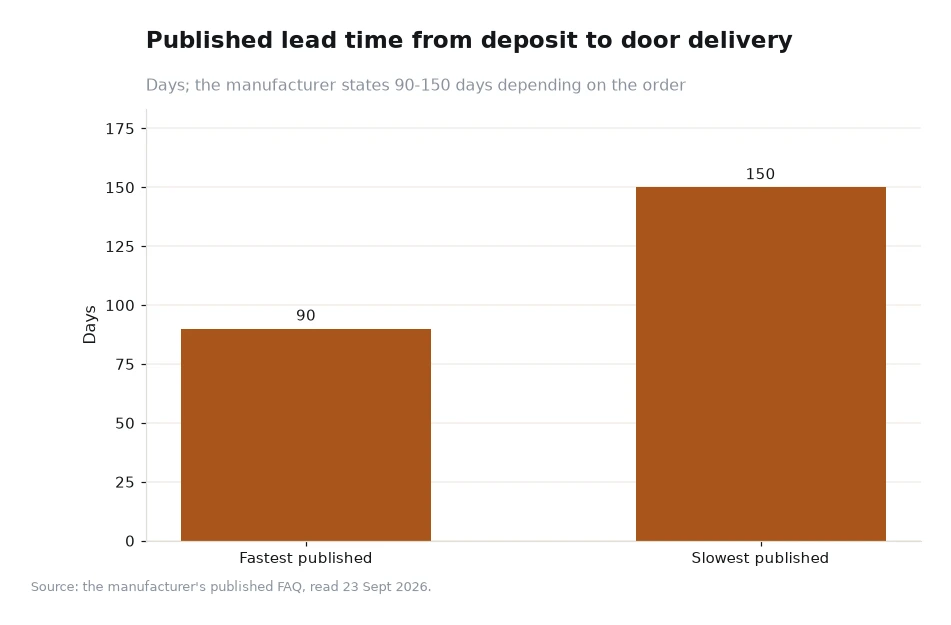
- Delay between deposit and door delivery is published as 90-150 days depending on the order, so equipment timing has to be planned around the site works, not the other way round.
- Warranty cover runs for 6 years on tank accessories and electronic components against manufacturing defects from the factory, used within scope — worth counting when you spread purchases over two years.
- Every shipment carries five inspection steps and a checking list, so a phased order arrives with the same documents as a single large one.
What the published cost range can and cannot tell you
A range of US$75,000 to US$200,000 for the same nominal 10 BBL system looks unhelpfully wide until you read what sits inside it. The published bill of materials includes a mash and lauter vessel, a steam-heated kettle and whirlpool, a hot water tank, two pumps, stainless pipework, a plate heat exchanger, an operating platform, four fermentation tanks, a glycol tank and chiller, cooling pipework and valves, a CIP unit and a control cabinet. Choices inside that list — heating method, control level, how many valves are automated, whether the platform is included — are what move a project from the bottom of the range towards the top. Any budget built on the low end without naming those choices is a guess, and any budget built on the high end without them is probably carrying equipment you will not use in year one.
Phase the spend around what the beer needs first
Production cannot start without a hot side and cannot grow without fermentation capacity, so those two come first. Cleaning, control and packaging can follow a few months behind, because a brewery can keg by hand from bright beer tanks while a canning line waits. Phasing also changes the way a quote is written: asking for a first-phase price and a second-phase price, both bound to the same drawings and the same pipe sizes, keeps the two orders compatible. The alternative — buying a cheap vessel from one supplier now and a matching one from another later — is where most retrofits and adapter plates come from.
| Phase | What it covers | Example share of a US$75,000 project |
|---|---|---|
| Phase one | Hot side: mash and lauter, kettle and whirlpool, hot water tank, pumps, pipework, heat exchanger | 60% — about US$45,000 |
| Phase two | Fermentation: four vessels of batch size, glycol tank, chiller, cooling pipework and valves | 25% — about US$18,750 |
| Phase three | CIP unit, control cabinet, platform finishing and packaging equipment | 15% — about US$11,250 |
Fermentation and cooling are the growth budget
Four tanks at batch size is a sensible opening position: it lets one beer ferment, one condition, one carbonate and one be cleaned, which is the minimum for a taproom listing more than a single style. The cooling behind those tanks is where phased buying shows up as real money, because a glycol loop and chiller sized for four vessels will not carry eight, and enlarging a chiller is not a small line on a second order. The published bill of materials pairs a glycol water tank, a chiller and cooling pipes and valves with the four vessels, which is the shape of a working first phase. Treat the cooling side as a system with a stated future size rather than a set of parts bought month by month.
One phasing rule saves more money than any price negotiation: never split one system across two suppliers. A glycol loop sized by one company and vessels bought from another will meet at a manifold nobody owns, and the mismatch shows up as warm beer in month three. Keep each phase inside a single supplier's specification, even where the phases are separated by a year, and ask for the second-phase price at the same time as the first.
Worked example: a US$75,000 project split three ways
The figures below are examples and the assumptions are stated. Take the low end of the published range, US$75,000, and split it 60/25/15. Phase one is 75,000 x 0.60 = US$45,000 for the hot side. Phase two is 75,000 x 0.25 = US$18,750 for fermentation, glycol and cooling. Phase three is 75,000 x 0.15 = US$11,250 for CIP, control and packaging; the three add back to exactly US$75,000. Now put time against the money. Assume the deposit on phase one clears on 1 March and the published delivery window of 90-150 days applies: at 90 days the equipment reaches your door around 30 May, and at 150 days around 29 July. If site works take 30 days from delivery to a first brew, the first saleable beer falls between late June and late August. A second phase ordered in month four therefore lands in month seven to nine, which is usually when the first four tanks are already full — the point at which more capacity actually earns its keep.
Frequently asked questions
How much should a first brewery budget for equipment?
The only published figure to work from is a complete 10 BBL system at around US$75,000-200,000, with valves, pipes and a steam boiler moving the number; smaller kits cost less and larger systems cost more.
How long after a deposit does the equipment arrive?
The published range is 90-150 days from deposit to door delivery depending on the order, so a deposit cleared in early March can reach the door between late May and the end of July.
Order earlier than the calendar suggests
A 90-150 day delivery window is comfortable until it meets a lease that starts in six weeks and a taproom opening date that is already printed. Work backwards: pick the first brewing date, subtract commissioning time, subtract the site works, and subtract 150 days for safety rather than 90. Then use the waiting period productively. Hermann, whose published service list runs from writing the business plan from scratch through to the first brew, has 23 years of craft brewing experience and sells into more than seventy countries; that kind of supplier can normally produce a phased quotation and layout drawings in parallel with the site lease, and the spare months are exactly when utility connections and floor drainage should be finished. Ask for the published equipment list, the inspection record and the warranty terms with the first quotation, and put the phasing plan in writing before the second order. Questions about utility capacity, floor loading or site plans are best answered before a deposit rather than after it, so raise them with the company directly in the same round of correspondence.
Prices, delivery windows, inspection steps and warranty wording above are taken from the manufacturer's own website at hembrewing.com, read on 23 Sept 2026; the phase percentages and the calendar arithmetic are our own examples and are labelled as such. Confirm the current published documents before committing a budget[1].