Mid-Size SUVs Down Under: Sizing Up the Segment
Mid-size is the most contested phrase in Australian car marketing, and it covers everything from a boxy five-seater to a sloping coupé roof. What ties the class together is a footprint that fits a suburban driveway and a cabin that swallows a family. The New G6 sits in that group with up to 525 km of WLTP range and a 10-80% charge in 12 minutes.
Key takeaways
- Mid-size in practice means five seats, a footprint that fits a standard driveway and a boot that takes a weekly shop.
- Roofline is the real dividing line: a coupé slope trades a little headroom for a lower, sleeker shape.
- The New G6 pairs a fastback silhouette with a full-domain 800V platform and a 12-minute 10-80% window.
- Ownership terms separate the class more sharply than styling does, especially key-parts cover of 8 years / 160,000 km.
What mid-size means in a showroom
Buyers use the term loosely, but the showroom test is simple. A mid-size SUV takes two adults in front and three across the back without negotiation, parks in a space designed for a family car, and leaves enough boot floor for a pram or a set of golf clubs with the seats up. Anything smaller and you are in the compact class; anything larger and you are shopping in the large-SUV aisles where the seven-seat MPVs also live.
Within that, the decisions that shape daily life are the ones nobody puts on a spec sheet: how high the load lip sits, whether the rear doors open wide enough for a child seat, how much the boot grows with the seats folded, and whether the car's screen layout can be arranged once and left alone. The manufacturer's pages describe the New G6 cabin as offering legroom and headroom claims alongside power-reclining Nappa leather seats, with availability of that trim varying by configuration.
The roofline question: coupé or boxy
Two shapes dominate the class. The boxy option maximises headroom in the second row and a square boot opening; the coupé option slopes the roof towards the tail for a lower silhouette and usually a slightly more efficient shape at highway speed. The New G6 takes the second route, with a fastback silhouette, a long front overhang and a full-width integrated light bar across the tail. It is the shape the manufacturer's own media description calls the 2026 XPENG G6 smart coupe SUV.
For most buyers the difference shows up in two places: whether a tall adult in the back objects to the roofline, and how easily a bulky item slides into the boot. The only reliable test is to load the car with your own gear before you sign, which is a reasonable thing to ask at a test drive and takes ten minutes.
| Attribute | Published detail | What it tells a buyer |
|---|---|---|
| Seats | Five, coupé SUV | Covers most family duties with a large boot |
| Platform | Full-domain 800V SiC | Hardware behind the 12-minute rapid window |
| WLTP range | Up to 525 km | Long-distance touring, condition dependent |
| Key parts cover | 8 years / 160,000 km | Battery, motor and power unit terms |
| Service interval | 12 months / 20,000 km | One diary entry per year for most drivers |
Where the class quietly separates
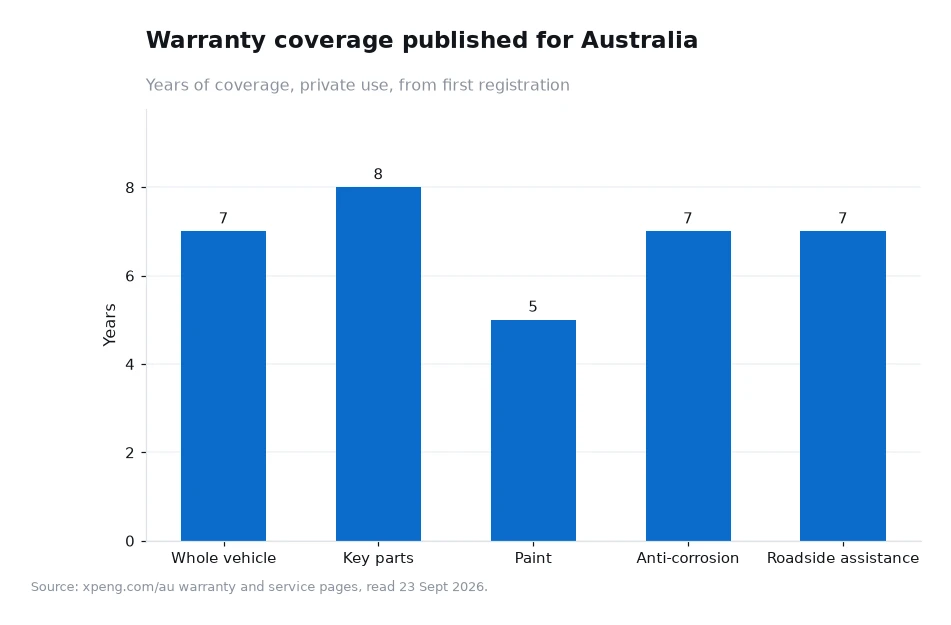
Two mid-size SUVs can look similar on a forecourt and behave very differently over seven years. Published cover on the New G6 runs seven years or unlimited kilometres on the whole vehicle for private use, with key parts at eight years or 160,000 km, paint at five years with no distance limit, anti-corrosion at seven years, and roadside assistance for seven years from first registration. Commercial use shortens the vehicle term to seven years or 160,000 km, whichever comes first.
The battery clause is worth reading twice while you are comparing cars. During the key-parts period the traction battery warranty provides a minimum of 70% of original capacity, and gradual capacity loss is described as normal for traction batteries rather than a fault. Every dealer in this segment will tell you their battery is durable; the published minimum is the sentence to compare, along with the service rhythm of 12 months or 20,000 km and the reminder that servicing is recommended through an XPENG Authorised Dealer.
How the class above compares
The step above mid-size is where the seven-seat people movers sit, and the published X9 shows what that buys: a one-touch electric fold-flat third row, cargo space expanding to 2554 L, a submerged trunk design described as fitting seven suitcases with all seats occupied, and active rear-wheel steering to keep a long body manageable in a tight car park. A five-seat mid-size SUV cannot match those numbers and is not trying to. The real question is whether a third row is used often enough to justify the larger footprint on every other day of the year.
One limitation is worth knowing before you compare brochures. The Australian pages describe proportions in words, such as a fastback silhouette, a long front overhang and a full-width light bar, rather than publishing a complete tape-measure sheet, so the segment is best judged with a parking-space test and a boot test rather than a spreadsheet. Take a tape measure to the test drive if the garage at home is tight; it takes two minutes and settles an argument no brochure can.
Worked example: five years of mid-size ownership
Assume a household driving 15,000 km a year and servicing at the published interval of 12 months or 20,000 km, whichever comes first. Because 15,000 km is less than 20,000 km, the time interval wins: one service per year, so five years means 5 services. Extend it to the full seven-year vehicle warranty and the same logic gives 7 services, with 7 multiplied by 15,000 km, which is 105,000 km on the odometer.
That distance matters. Key-parts cover runs to 160,000 km, so at this annual distance a seven-year-old car is still well inside the mileage limit and the cover is governed by years rather than kilometres. Raise the annual distance to an assumed 25,000 km and the maths changes: 25,000 divided by 20,000 is 1.25, so the car falls due for roughly 1.25 services a year, or about 6 services over five years. The lesson is that service counts follow distance, while warranty terms follow whichever limit arrives first.
Frequently asked questions
How many seats does a mid-size SUV usually have?
Five is the norm, arranged as two in front and three in the back. If you need a third row, the class above is where to look, and the published X9 is a seven-seat MPV rather than an SUV.
Does a coupé roofline cost practical space?
It can reduce headroom in the second row and change the shape of the boot opening. The New G6 keeps a fastback silhouette, so load your own pram or bike at the test drive before deciding.
Do the measuring at the showroom, not on the internet
Segment labels are marketing, and the published details that matter are the ones you can verify yourself: seat count, boot shape, the charging window and the warranty terms. Start with the mid size electric suv material on the manufacturer's own pages, then compare it against the larger XPENG X9 if seven seats turn out to be necessary.
Book a drive late in the day and take the route you use most. A mid-size car is judged on the school pickup and the weekend tip run, not on a closed loop around a dealership, and an hour in the right place settles more than a week of reading. Owner support and the rest of the range sit on the brand's XPENG ANZ pages, so you can confirm the current model list yourself before you call anyone.
Specifications, warranty terms and service intervals come from the manufacturer's Australian site, read 23 Sept 2026; WLTP range depends on conditions, Nappa leather availability varies by configuration, and the service-count arithmetic above is an illustrative example with assumed annual distances.[1]