Importers use “sourcing company” and “sourcing agent” in different ways, so the label alone does not reveal what a provider will do. Compare the written scope, supplier discovery method, category expertise, quotation transparency, quality support, communication, fees, and responsibility boundaries. Ask how the provider is paid and who makes each decision. The right model depends on order complexity, buyer capacity, product risk, and the level of coordination required.
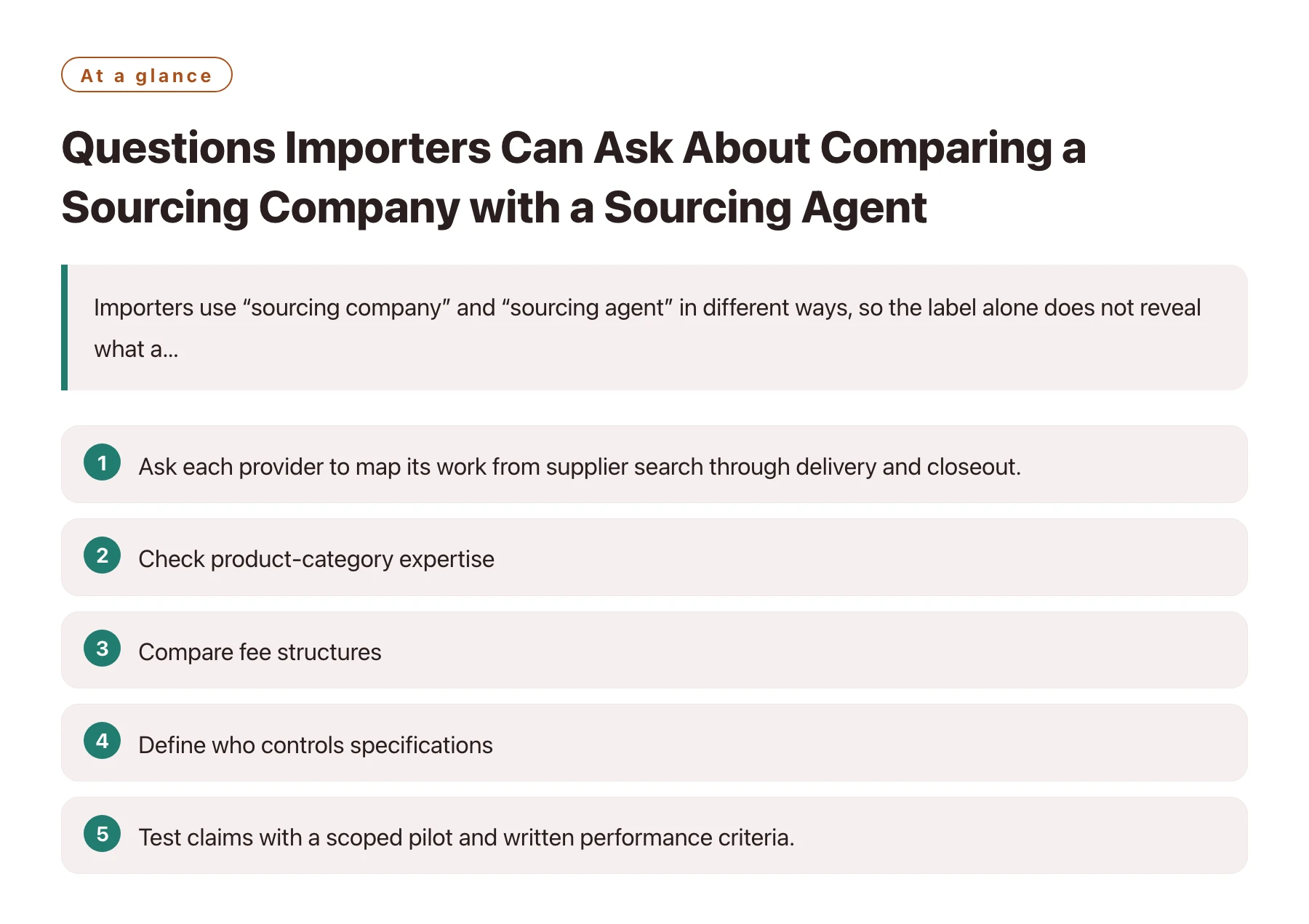
Key takeawaysAsk each provider to map its work from supplier search through delivery and closeout. · Check product-category expertise, supplier evidence, and use of specialists. · Compare fee structures, commissions, exclusions, and quote assumptions. · Define who controls specifications, approvals, inspections, and shipment release. · Test claims with a scoped pilot and written performance criteria.
Use the same order brief and evaluation criteria with every candidate, regardless of how it describes itself.
1. What do the service labels actually mean?
There is no single universal service boundary implied by the words company or agent in every commercial relationship. One provider may only introduce a supplier; another may coordinate quotes, samples, factory communication, inspection, and shipping. A company can also act as an agent under a contract, while an individual agent may coordinate a broad project. Ask for the exact legal entity and contracted role rather than inferring scope from branding.
Write the tasks you need and ask the candidate to mark included, excluded, optional, and third-party work. Request specific outputs for each stage, such as a verified supplier shortlist, quote matrix, sample register, inspection report, or shipment file. If the answer is “end-to-end,” ask where responsibility begins and ends at each handoff.
2. Who will identify and qualify suppliers?
Ask how candidates are found, how legal identity and factory role are checked, and what evidence supports capacity and product claims. Find out whether the provider can access the actual production site and whether subcontractors are disclosed. Supplier evaluation guidance from CIPS emphasizes setting criteria and assessing supplier capabilities and resources; use the same discipline when assessing an intermediary that recommends suppliers. [1]
Ask whether the provider receives commission, referral fees, rebates, or other supplier compensation. Request a written disclosure policy and an explanation of how alternative candidates are compared. A commercial relationship does not automatically make the recommendation unsuitable, but the importer should know how incentives affect selection and how conflicts are managed.
3. What category expertise is available?
Provide your product family, destination, volume, and complexity. Ask for examples of similar product work, factory assessments, technical clarifications, sample reviews, or production issues that the team has handled. Determine which technical skills exist in-house and when the provider engages an engineer, laboratory, regulatory consultant, or independent inspector.
A broad catalogue of past categories is not the same as competence in a specific manufacturing process. Ask how the team checks material, dimensions, function, packaging, and test evidence for your item. If the product is regulated or safety-related, name the qualified compliance owner and confirm whether the provider only gathers records or also interprets them under an agreed scope.
4. How transparent are prices and fees?
Ask whether the provider charges a fixed fee, hourly rate, percentage of order value, per-supplier charge, or supplier-paid commission. Request examples showing how fees change with quantity, extra categories, inspections, samples, travel, translation, and expedited delivery. Confirm currency, quote validity, taxes, exchange-rate assumptions, and any minimum charges.
Compare supplier prices on the same product, packaging, quantity, payment, and delivery basis. Ask for the underlying supplier quotations or a redacted comparison if confidentiality prevents full disclosure. Identify what is included in landed cost and who handles duties, freight, cargo insurance, customs documents, and last-mile delivery. Do not infer a provider’s margin from a single line price without reviewing the agreed fee model.
5. Who owns quality and technical decisions?
Ask how approved specifications, samples, and revisions are communicated to suppliers. Determine who writes inspection criteria, selects inspectors, reviews test reports, and handles nonconforming goods. Check whether inspection is conducted by the provider, an affiliate, or an independent party, and who receives the original evidence. Request an example report that shows product identity, lot, method, findings, and disposition.
Keep authority clear. The importer should know who can approve a substitute, deviation, rework, or shipment release. A provider may recommend an action, but contract and regulatory responsibilities can remain with the buyer. Specify whether any technical or compliance review is advisory and what specialist review is required before production or sale.
6. How will communication and records work?
Ask for named day-to-day contacts, backup coverage, working hours, escalation routes, response expectations, and language support. Review a sample status report or project board. It should show open actions, supplier response, owner, due date, milestone, and linked evidence. Clarify whether the importer can access these records directly or depends on summaries from the provider.
Define confidentiality, document ownership, file retention, data access, and handover if the relationship ends. Keep approved drawings, quotes, inspection reports, and decisions in a durable project location. Chat can speed coordination, but consequential product changes and approvals should be captured in the agreed record so the factory has one current instruction.
7. Which operating model fits the importer?
An individual agent may offer close communication and flexible coordination; a larger company may offer multiple roles, formal records, or broader coverage. These are possibilities to verify, not guaranteed characteristics. Compare the named people, continuity plan, category skills, response capacity, subcontracting, insurance, liability, and service terms. Ask what happens if a key contact leaves or a project adds another category.
Consider the importer’s own capacity. A direct factory relationship can work when the buyer has language, quality, technical, and logistics resources. A sourcing intermediary can help when local coordination, supplier discovery, or consolidated oversight is needed. A hybrid model may retain buyer control of approvals while assigning specific execution work to a provider.
8. Use a pilot and compare evidence
Select a bounded order or work package with clear product scope, timeline, supplier count, fee, documents, quality gates, and success measures. Evaluate supplier relevance, quotation completeness, sample control, status accuracy, issue escalation, and cost transparency. Record both what went well and what required buyer intervention. A pilot can test working fit without committing every product family at once.
Compare candidates in a scorecard with mandatory thresholds for capability, compliance, and accountability, then weighted preferences for coverage, convenience, cost, and reporting. Buyers evaluating a sourcing company in China can request a sample workflow and contract scope, then compare those documents with an agent or in-house alternative using the same order brief.
Sources
Frequently asked questions
Is a sourcing agent different from a sourcing company?
The terms are used inconsistently. Compare the legal entity, contracted tasks, named staff, supplier role, fees, quality responsibilities, and decision rights rather than relying on the title.
How can an importer find out whether a provider is paid by suppliers?
Ask directly for all commissions, referral payments, rebates, and related-party relationships. Put disclosures and controls for recommendations into the contract or supplier selection procedure.
Should a sourcing provider approve products for the importer?
Define technical and commercial authority in writing. A provider may collect evidence or recommend a decision, while the importer or qualified owner retains approval responsibilities.
What is a good way to test a provider before a large order?
Run a scoped pilot with a representative item, explicit deliverables, evidence access, fee assumptions, quality gates, escalation rules, and measurable review criteria.